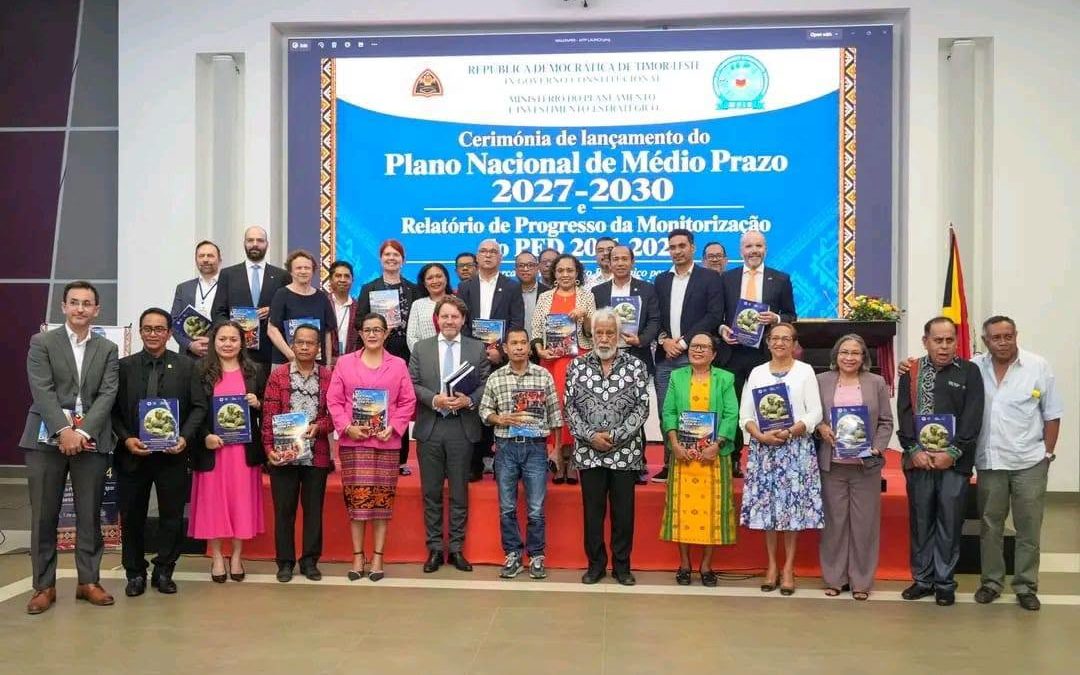
Four-year plan focuses on economic diversification, people-centred development, stronger institutions and economic-driven infrastructure.
DILI, TIMOR-LESTE | 1 OCTOBER 2026 — The Government of Timor-Leste, through the Ministry of Planning and Strategic Investment, today launches the National Mid-Term Plan 2027–2030, together with the Strategic Development Plan 2011–2024 Monitoring Report, under the theme “Strengthening Strategic Planning for Sustainable and Inclusive Development.”
The National Mid-Term Plan establishes the Government’s principal development priorities for the next four years and provides a framework for advancing the final phase of implementation of Timor-Leste’s Strategic Development Plan 2011–2030.
His Excellency the Prime Minister, Kay Rala Xanana Gusmão, described the 2027–2030 period as decisive for the country’s long-term transformation.
The Plan seeks to contribute to building a prosperous, inclusive, resilient and economically strong Timor-Leste, creating greater opportunities for its people while progressively strengthening the productive sectors of the economy.
The Government will strengthen efforts to diversify the national economy, increase domestic production and support the development of agriculture, tourism, the blue economy and the private sector. These efforts are intended to expand productive economic activity and create decent employment opportunities, particularly for young people.
The Plan places people at the center of national development, with continued investment in education, health, nutrition and skills development. These investments aim to strengthen human capital and equip future generations with the knowledge and capabilities required to participate in Timor-Leste’s social and economic transformation.
The Government will continue strengthening public institutions, fiscal discipline, accountability and the effectiveness of public resource management. The Plan places increased emphasis on ensuring that public expenditure, programmes and policies translate into concrete and measurable results for citizens.
Infrastructure investment will be increasingly linked to wider economic and social outcomes. Under the Plan, infrastructure performance will not be assessed only through physical outputs such as kilometres of roads constructed, but also through the benefits those investments deliver to communities and the economy. Infrastructure development will therefore seek to improve farmers’ access to markets, connectivity to tourism destinations, municipal development and access to public services.
The Government will ensure that Gender Equality, Disability and Social Inclusion (GEDSI), as well as climate and environmental considerations, are integrated across all policies. Rules, mechanisms and monitoring systems will also be strengthened to track progress and ensure
effective implementation.
The Prime Minister emphasized that implementation of the National Mid-Term Plan is not the responsibility of Government alone. Successful implementation will require cooperation among Government institutions, the private sector, civil society, religious organisations, communities, young people and development partners.
The Government intends the National Mid-Term Plan 2027–2030 to provide a common framework connecting national priorities, public investment, institutional performance and measurable development results.
— END —
For documentation please click on the link: